
If you feel nervous—or even unqualified—to teach dance, you’re not alone. Many music and general classroom teachers suddenly find dance added to their teaching responsibilities with little training and even fewer resources.
But here’s the truth: you don’t need to be a dance expert to teach movement with confidence.
All you need are clear outcomes, manageable routines, and tools that help you guide students through creativity, expression, and safe movement.
And with the right structure, dance can become one of the most joyful, successful parts of your arts program.
Dance builds skills that reach far beyond the music or arts classroom, including:
These outcomes align beautifully with music curriculum expectations—and they’re accessible to any teacher with the right support.
You don’t need to teach full choreography right away. Begin with simple movement ideas such as:
These intro activities build confidence and help students understand that dance doesn’t mean “performing on stage”—it means expressing ideas through movement.
💡 Tip: Scarves, ribbons, or beanbags make exploration feel more playful and less intimidating.
Visual aids take the pressure off you to come up with movement ideas on the spot. Try using:
Each card provides a single movement type—jump, twist, stretch, step, slide—and students can interpret them in their own way.
This makes dance feel structured and creative, without requiring you to invent choreography.
If you’re a music teacher, dance becomes approachable when you think of it as:
movement that shows beat, rhythm, tempo, form, and dynamics.
Try pairing movements with musical opposites:
You’re still addressing dance expectations—but through a lens that feels familiar.
You already have strong teaching instincts—use them in dance!
Try this structure:
Warm-Up
Simple movement, body awareness, stretching, echo actions.
Skill Practice
Body percussion patterns, shape-making, moving in levels (high/medium/low), exploring pathways (straight/curved/zag).
Creative Task
Students choreograph a 4–8 count sequence alone or in small groups.
Share & Reflect
Students perform for a partner or small group and reflect on effort, creativity, and musical connection.
This creates consistency and safety for students—and reduces planning stress for you.
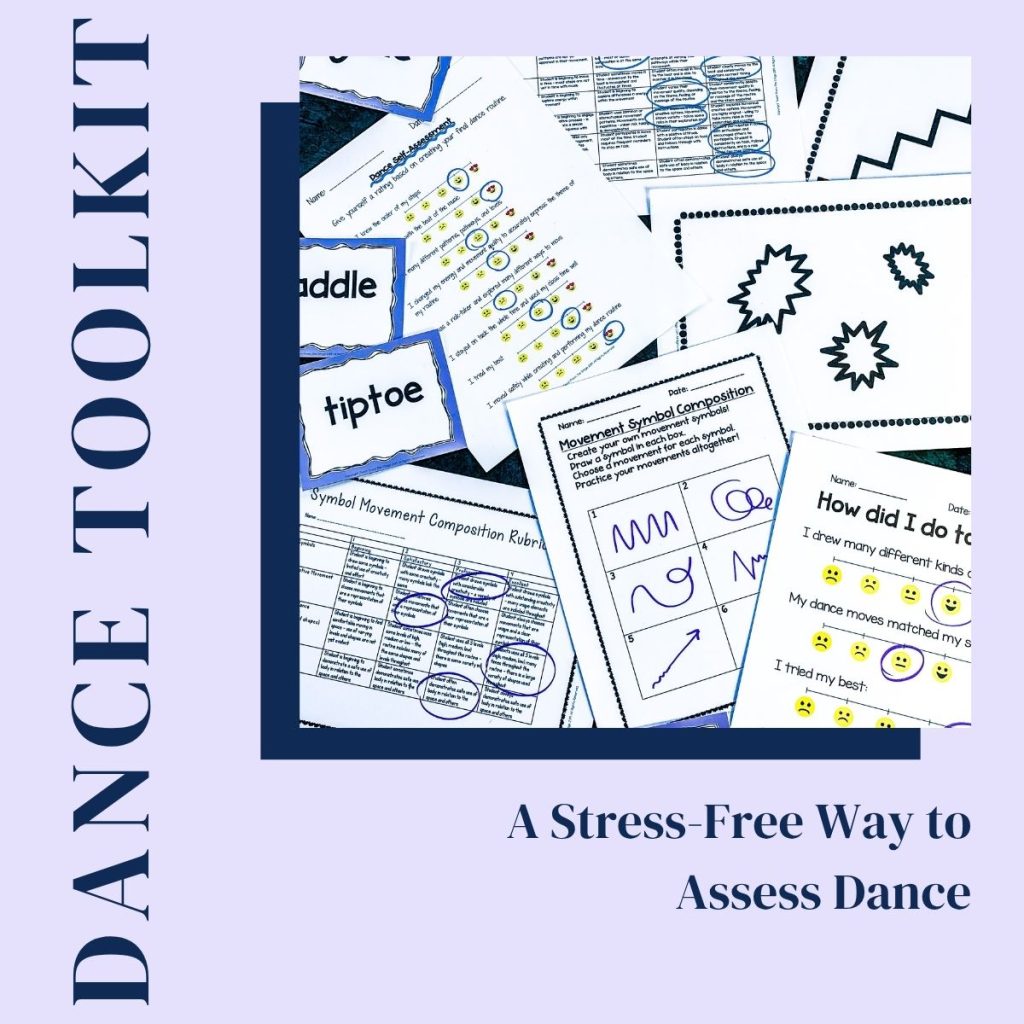
One of the hardest parts of teaching dance is grading it.
A clear, student-friendly rubric helps with:
Pairing a rubric with a self-reflection page helps students evaluate their own:
This closes the feedback loop—and makes dance assessment meaningful.
👉 Get a ready-to-use rubric & reflection sheet:
Dance Unit Assessment Toolbox
You don’t need to be the choreographer—your students can be!
Try group tasks like:
Students love taking ownership, and you get to step into a facilitator role rather than a performer role.
Remember:
Dance in school is not about perfect technique.
It’s about:
When students feel safe taking risks, they participate more fully—and the whole class becomes more confident.
Give yourself the same grace.
You don’t have to be a dancer.
You just have to be willing to move.
You don’t have to create resources from scratch or guess your way through assessment. With tools that support structure, creativity, and reflection, you can bring dance into your classroom confidently and joyfully.
The Dance Unit Assessment Toolbox includes:
🛒 Get it here → Dance Unit Assessment Toolbox
And for creative movement prompts that make dance lessons easier than ever:
🛒 Try the Movement Cards → Movement Cards for the Music Classroom
Together, these resources help you teach dance confidently—even if you’re not a dance teacher.

My name is Alessandra and I am a Kindergarten-Grade 8 Teacher of the Arts, specializing in music and dance education. Based in Toronto, Canada, I teach 800+ students a week and am a huge advocate for the arts. I graduated with a Bachelors of Music Therapy & Masters of Education, and I am passionate about fostering a quality music education program for every learner.